macOSTHIS MACHINE
Universal disk image. Apple silicon and Intel.
Disk image · universal
8a44139f77c8f15db03840ac0741f20c2290845aa2800e0e4386e4445724aec1FUTURESUB
// ONE ABOARD — COMBAT CONSOLE
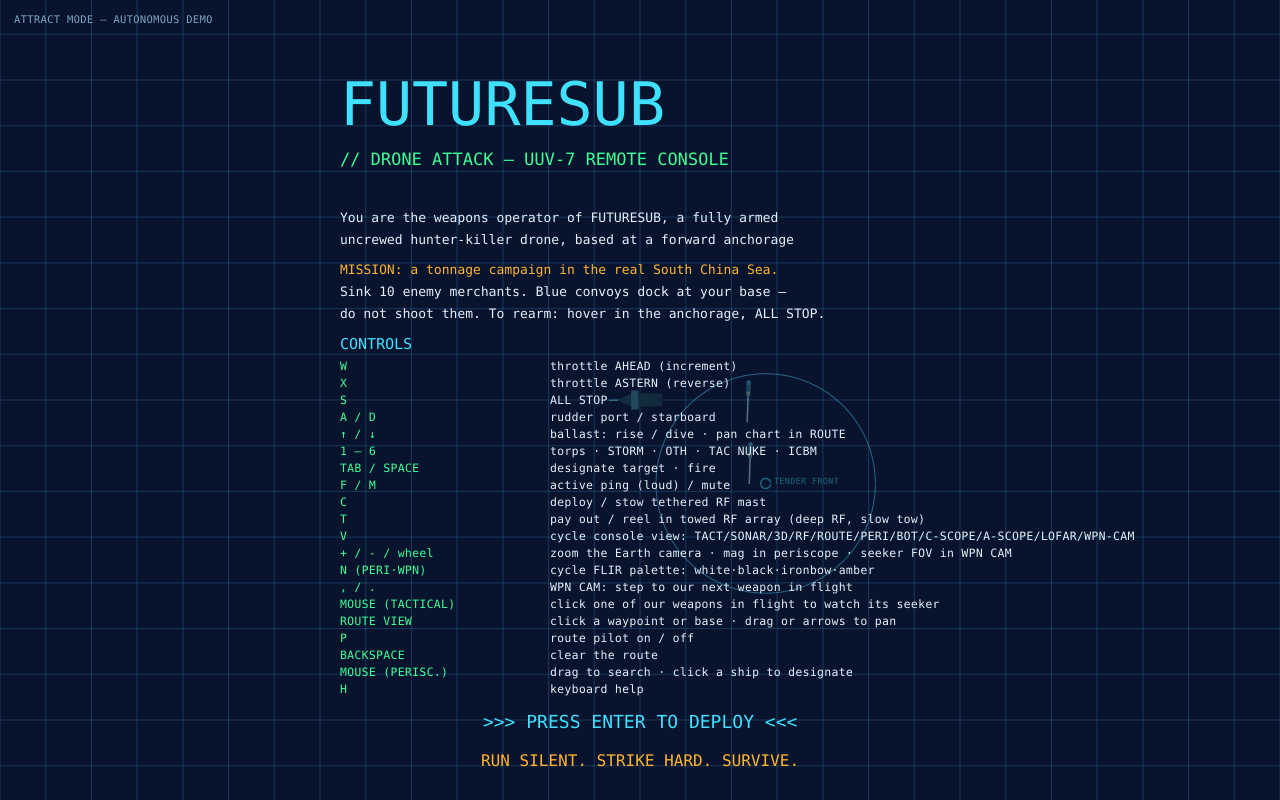
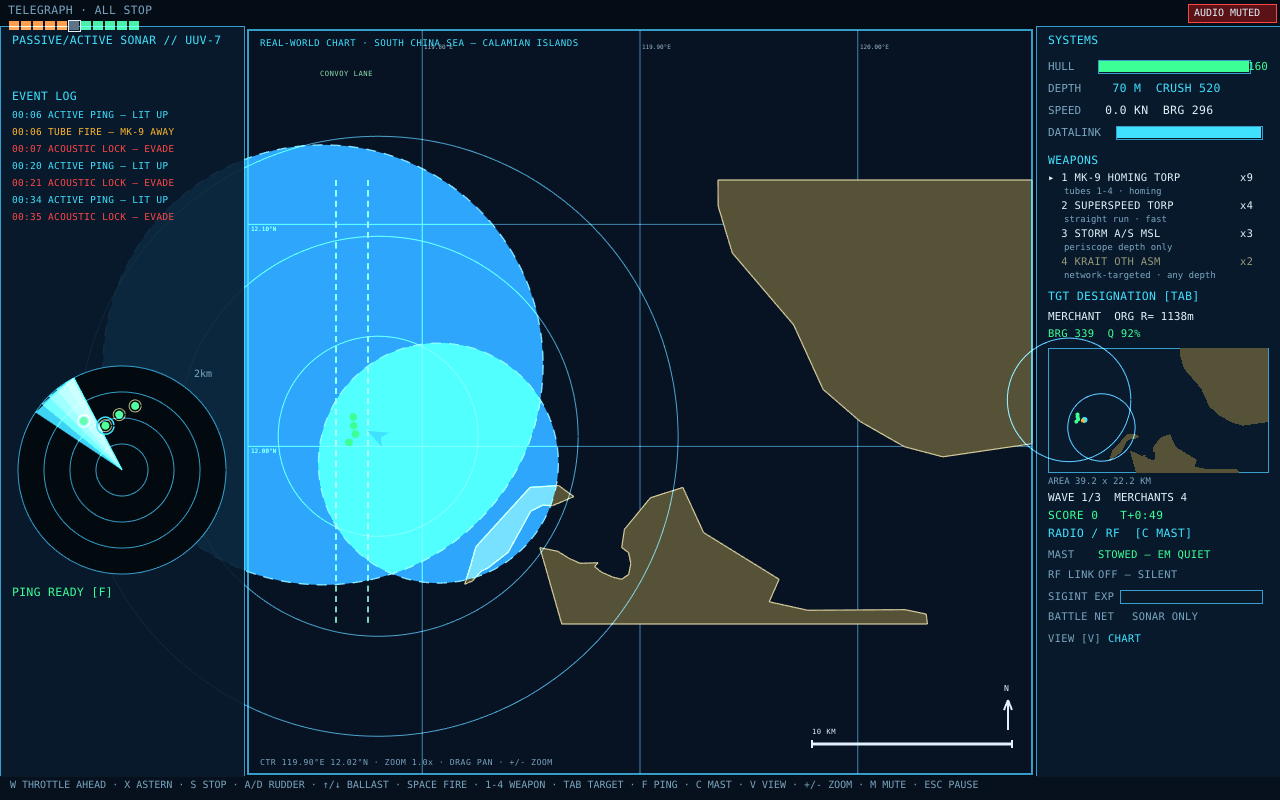
One person is aboard. FUTURESUB is the boat's own combat console, a hunter-killer submarine on a real chart of the South China Sea, off the Calamian Islands. It is also the specimen for a local-LLM test bed: one machine, a long unattended run, and a finished desktop product at the end.
MISSION: the patrol starts in peacetime. Ten merchants fill the Calamian quota and post the transit. The quota is not the whole win. The war ends when every enemy base, drone, and ship is gone. Amber is neutral. Do not shoot blue. Rearm at the tender, all stop, off the bottom.
Universal disk image. Apple silicon and Intel.
8a44139f77c8f15db03840ac0741f20c2290845aa2800e0e4386e4445724aec1NSIS installer. SmartScreen will warn; this build is unsigned.
35449abdec803d080e4883836390b67b7fdd437d834903825030a10cf0ec4ddea87c20dce5eb7c367b7483641c1be068270831a2d216f85ead7a836b08459e00deb for Debian and Ubuntu, or a tarball for anything else.
4b1e5625e78457303498e994097c68ff546ffcb9f5d980687dba8927f97bc871a08ada7a664cdcd72eb059d6e6e078a3eee34b36a615dddc3ec797e974abea1f40ebb24f1ae1129cc5089726f3dfd3fd8f357bd8af14399bd6e2dc37345d87c416943fbbccb2abddfaa0d18f63a21d87796b17fd500b88f13e07f84dc85a9a6fThese builds are unsigned. On a Mac, right-click the app and choose Open the first time. On Windows, SmartScreen will offer More info, then Run anyway.
The boat starts moored at TENDER FRONT, a forward anchorage in the South China Sea. The patrol starts in peacetime, and war traffic is not at the pier. Slip the mooring and the patrol clock runs. The war follows a few minutes later, or at once if you shoot a civilian, shoot a friendly, or destroy an enemy base. Every departure is a new sortie.
Hostile merchants are not alongside at the pier. When the war starts they are already underway on the outer patrol, past the lane, and they steer into the convoy band. The radio still names PALAWAN STAGING. Replacements come in the same way, from outside the fight. Neutral cargo, fishing boats, and one cruise ship are amber, and they are not targets. Friendly logistics are a larger group, with two friendly escorts, cycling between TENDER FRONT and TENDER LAGONA. They are marked blue. Sinking one costs 2000 points.
Rearm at any friendly base: come inside the 1.2 km tender ring, all stop, off the bottom. The home waters are a sanctuary. Hostiles will not fight you there. Ten enemy merchants fill the Calamian quota and post the transit west. The war ends when every enemy base, drone, and ship is gone, and no enemy torpedo or strike weapon is still in flight. Lose the hull and the patrol is over. A strategic missile strike scores, and the patrol keeps running.
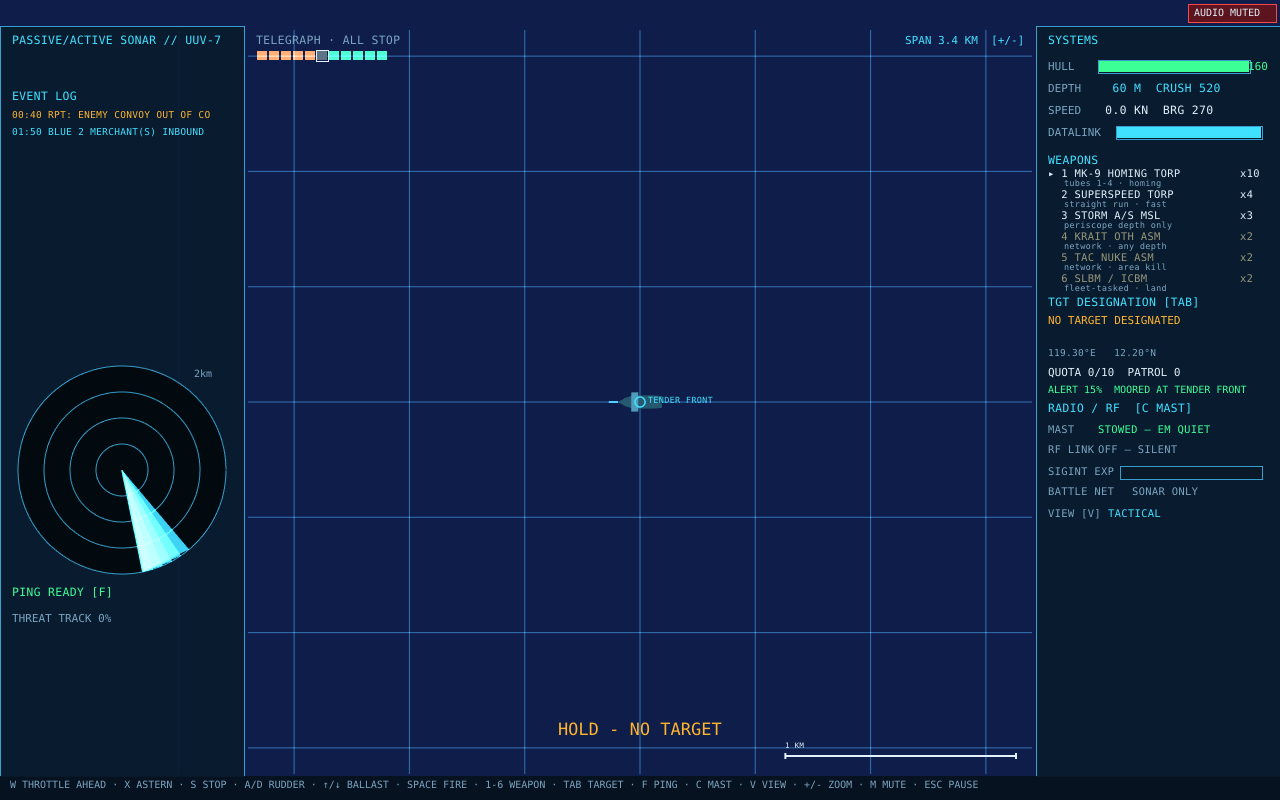
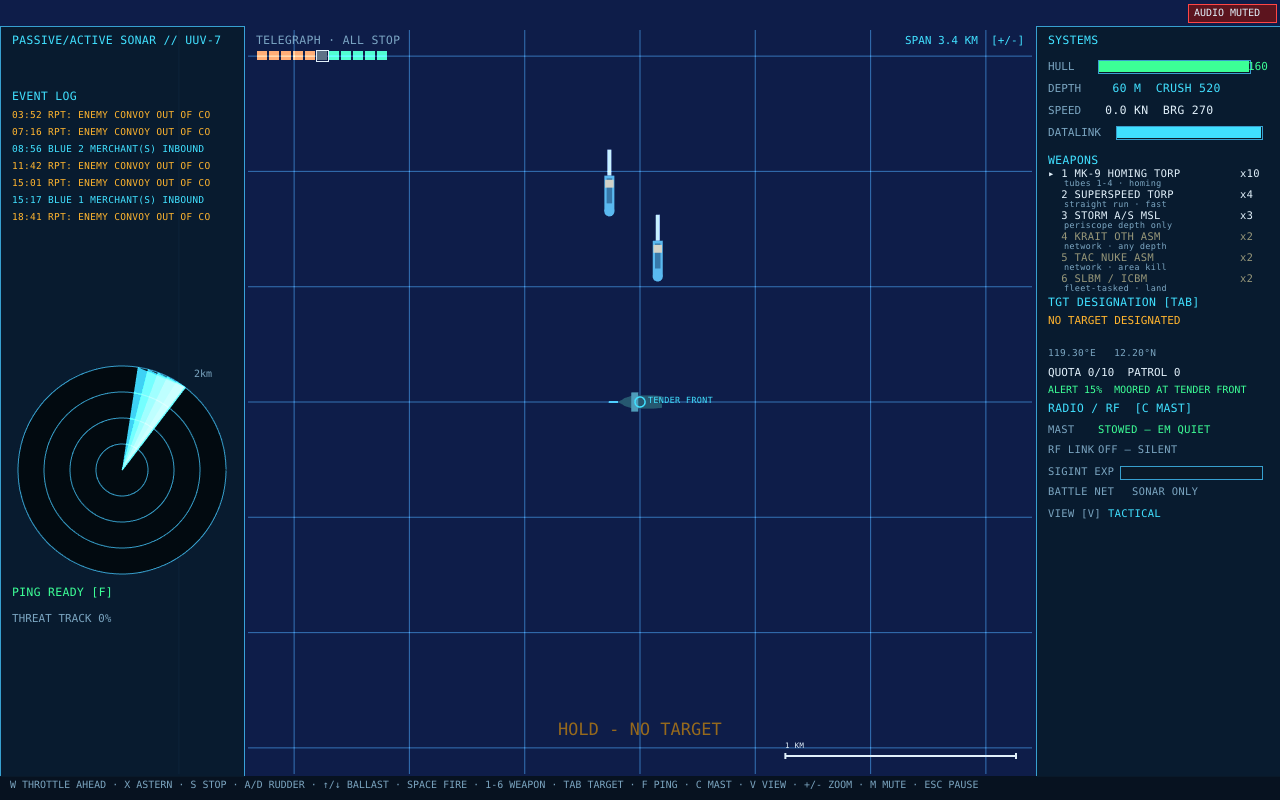
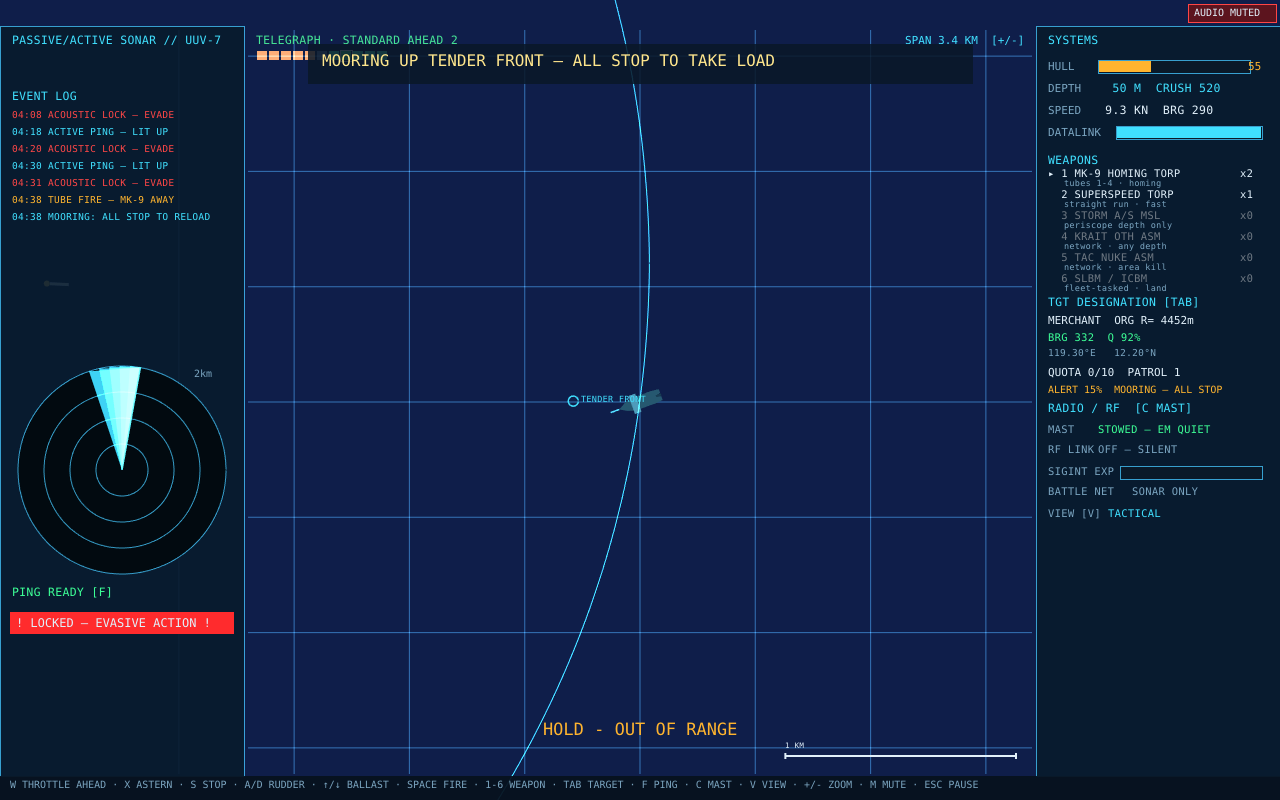
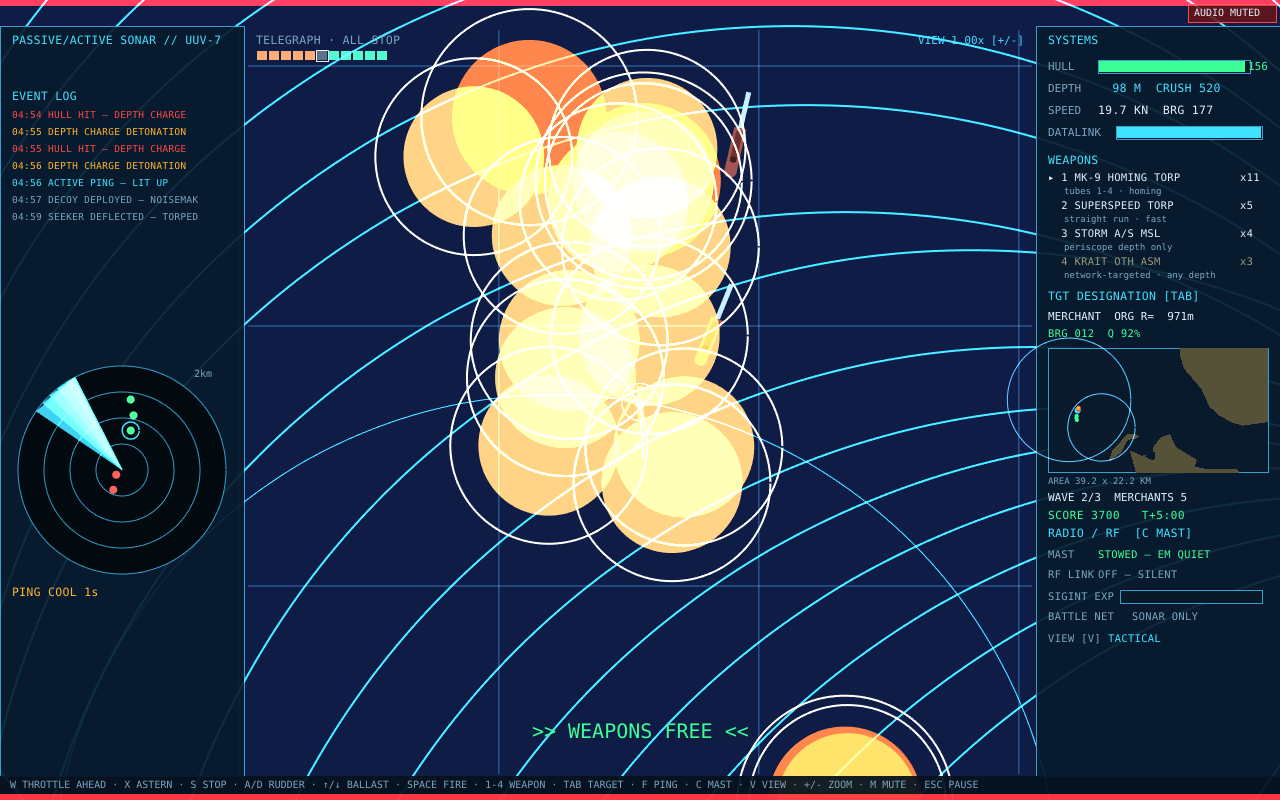
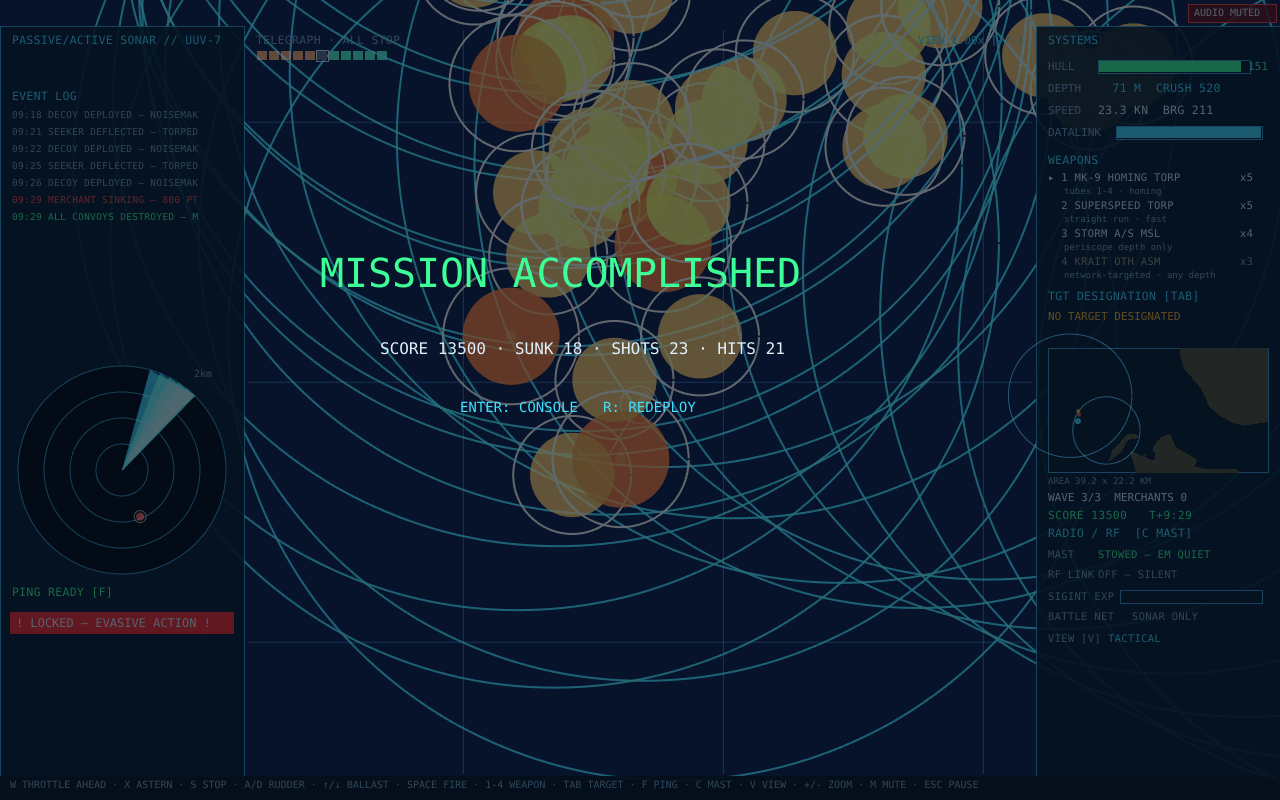
The loadout is sized for a long tonnage war: 24 homing torpedoes, 10 supercavitating, 10 STORM, 8 over-the-horizon cruise missiles, 4 tactical nuclear cruise missiles, 4 submarine-launched ballistic missiles, and 10 interceptors. A visit to the tender fills all of it.
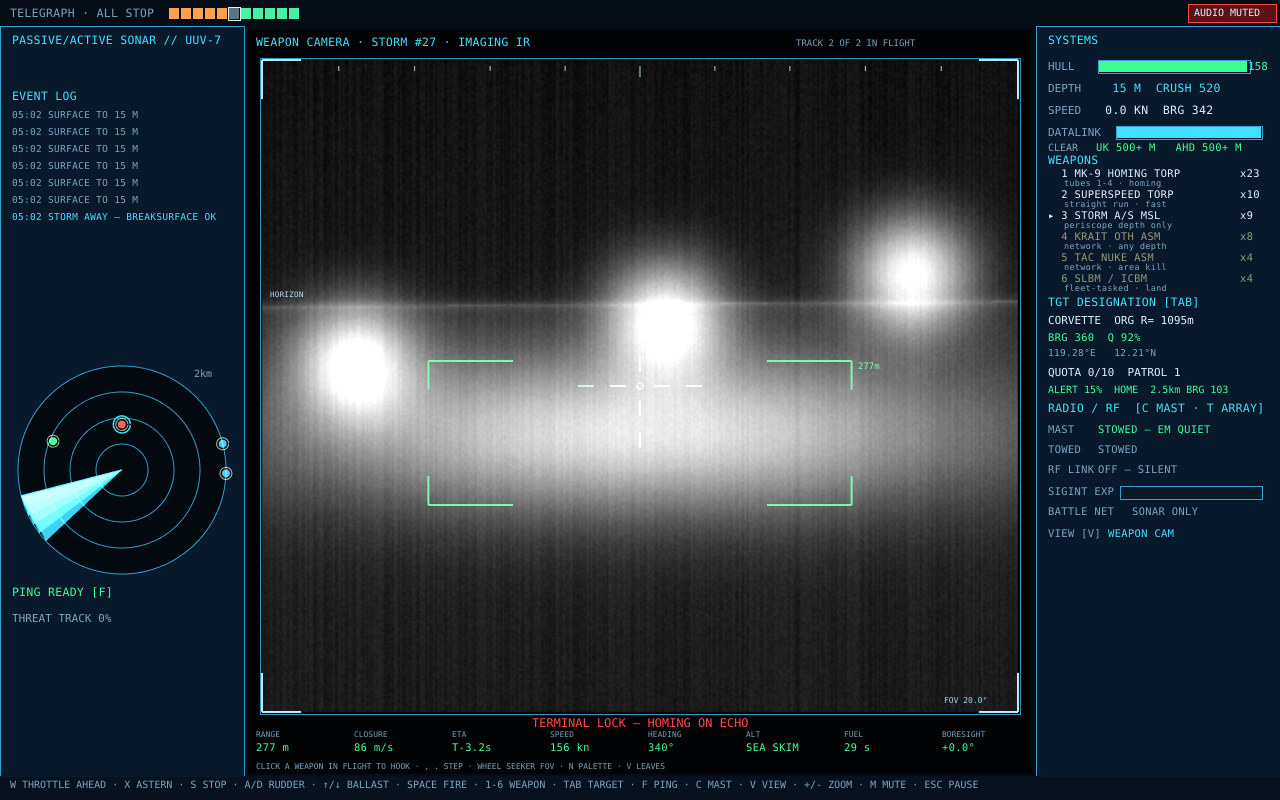
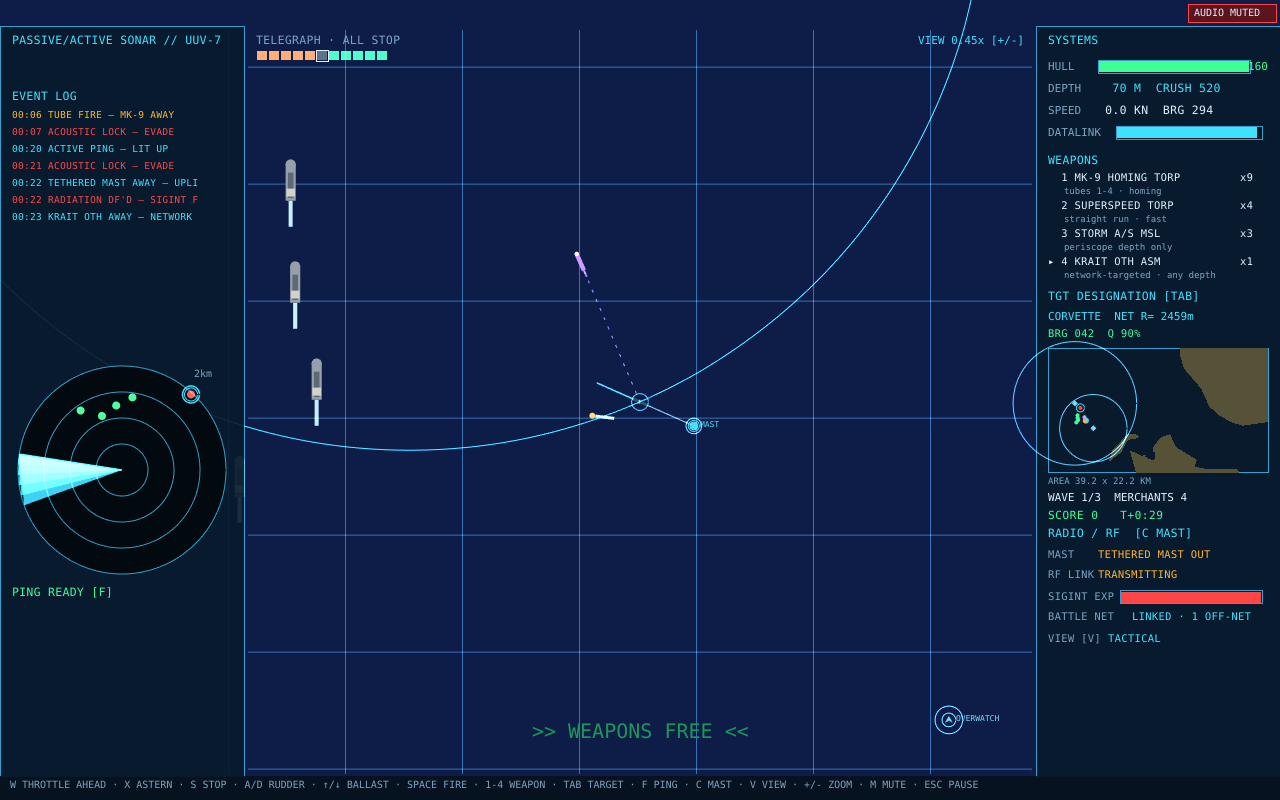
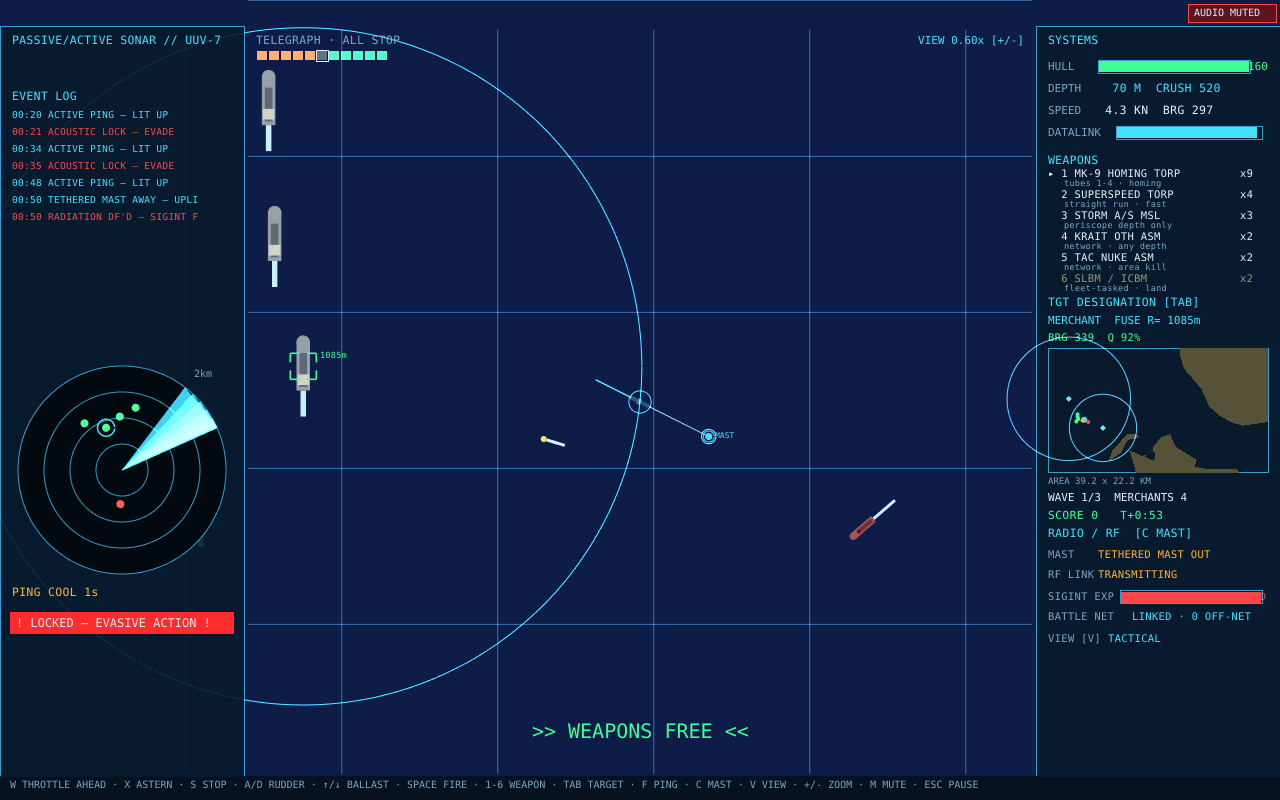
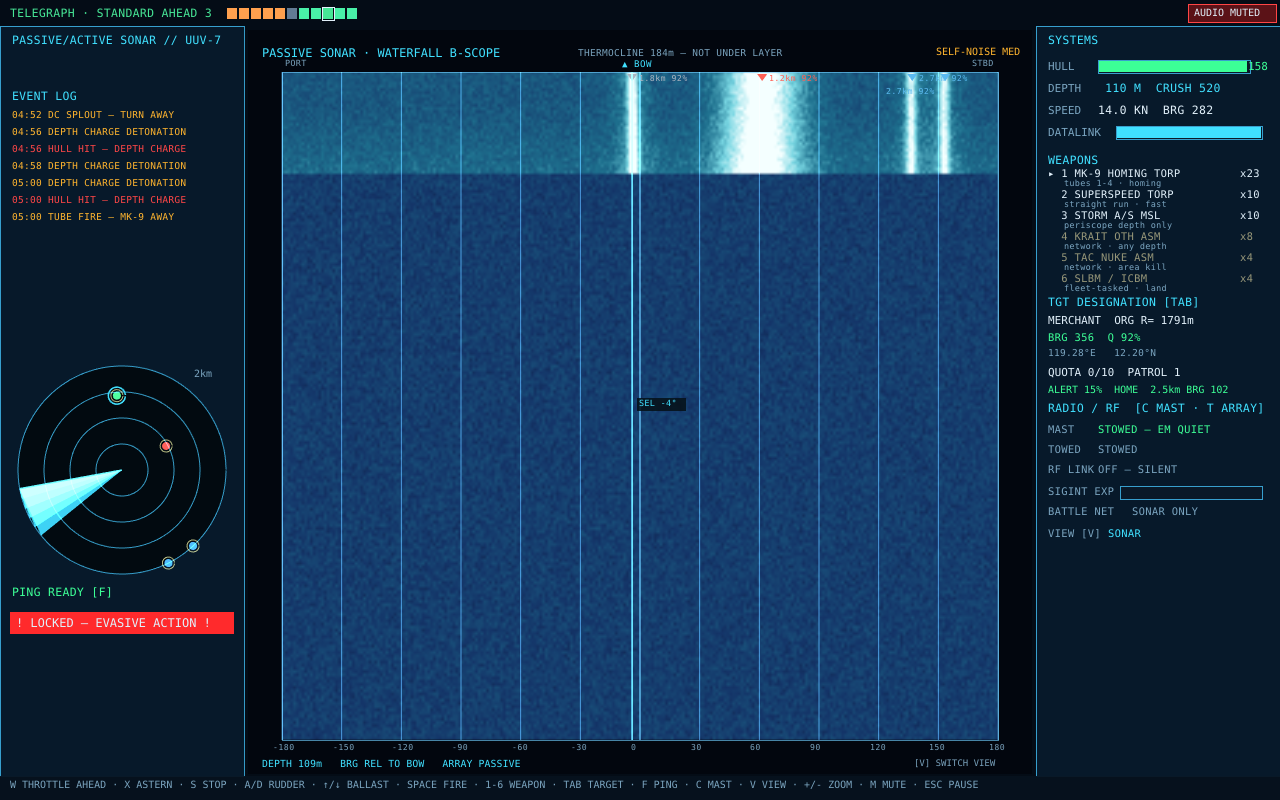
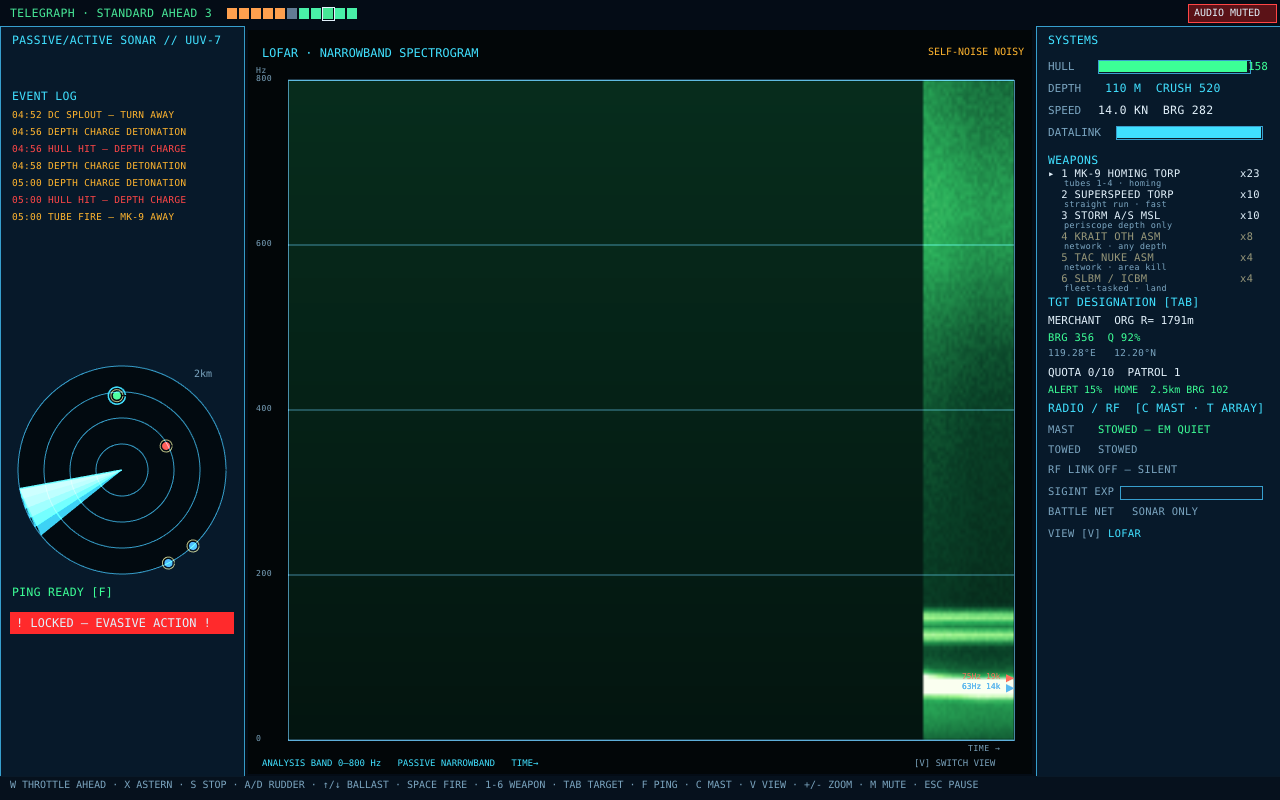
V cycles the centre view. The side panels stay up. Passive sonar is a bearing-by-time waterfall: a merchant paints a thin shaft-rate line, an escort paints a broad cavitation blob, and your own speed washes the scope with self-noise. The C-scope, A-scope, and LOFAR are the other three tubes a watchstander would actually have.
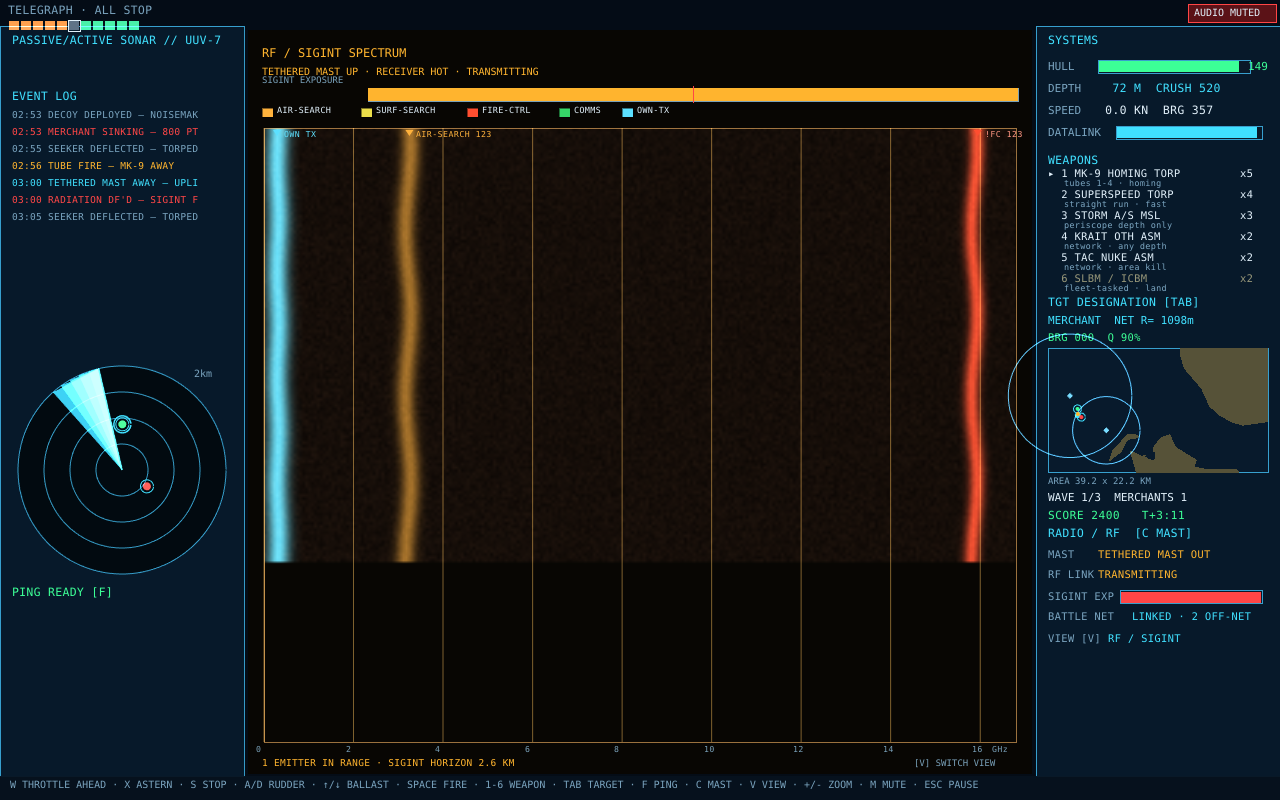
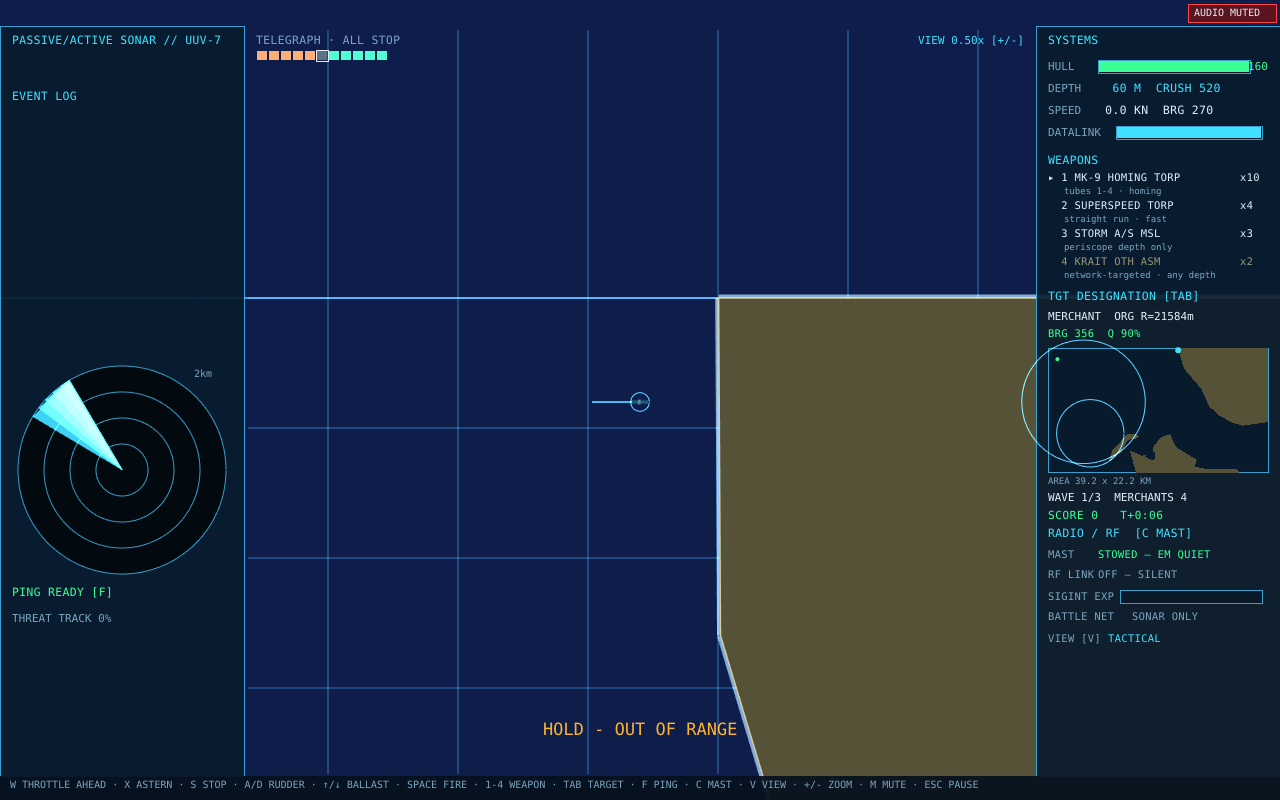
The periscope is a thermal picture of the real coastline, useful only at 11 metres or shallower. Ships are heat, hottest at the funnel, and land hides whatever is behind it. The RF scope is the other side of radiating: your own transmission, their fire-control radar, and the exposure bar that fills until they have a fix.
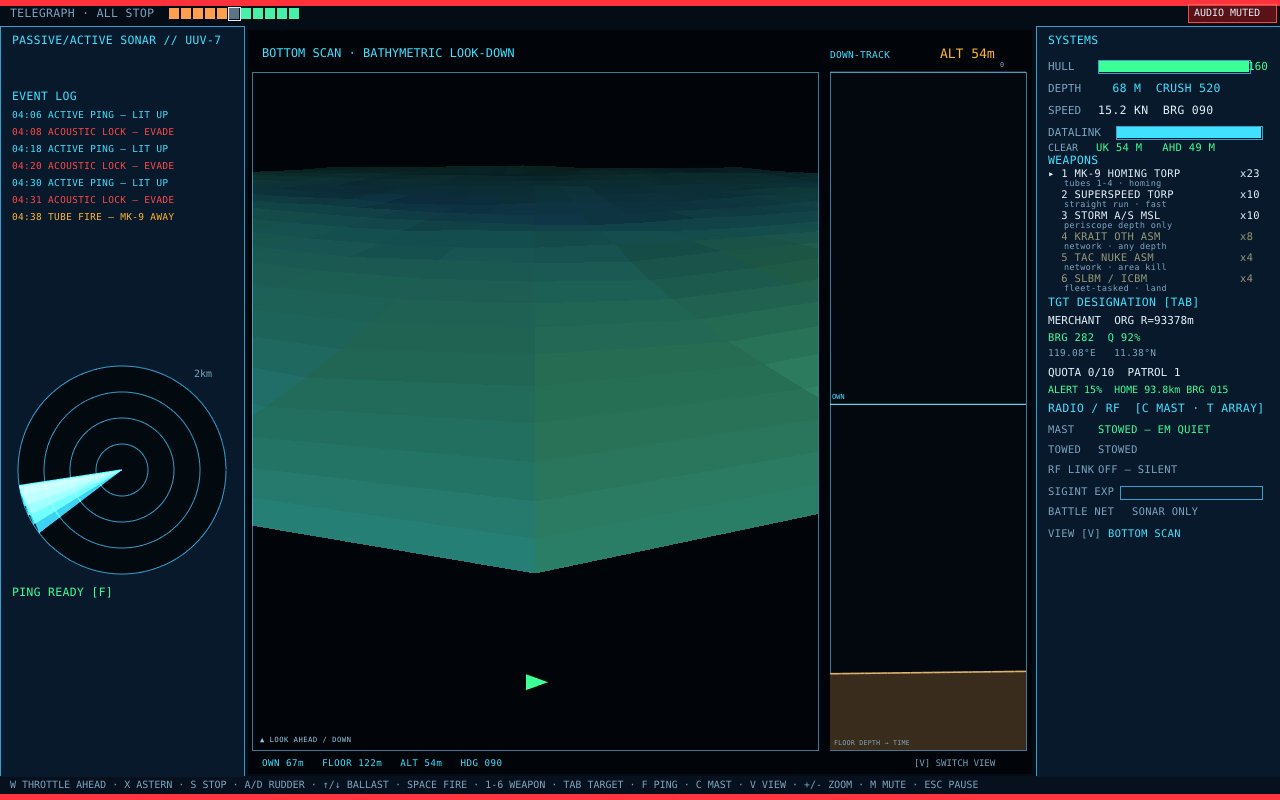
The bottom scan reads the same seafloor the boat can grind on. A 5-arc-minute chart cannot see a ledge, so procedural relief fills that band. The warning, the view, and the boat's own climb-off-the-floor behaviour all use that one floor.
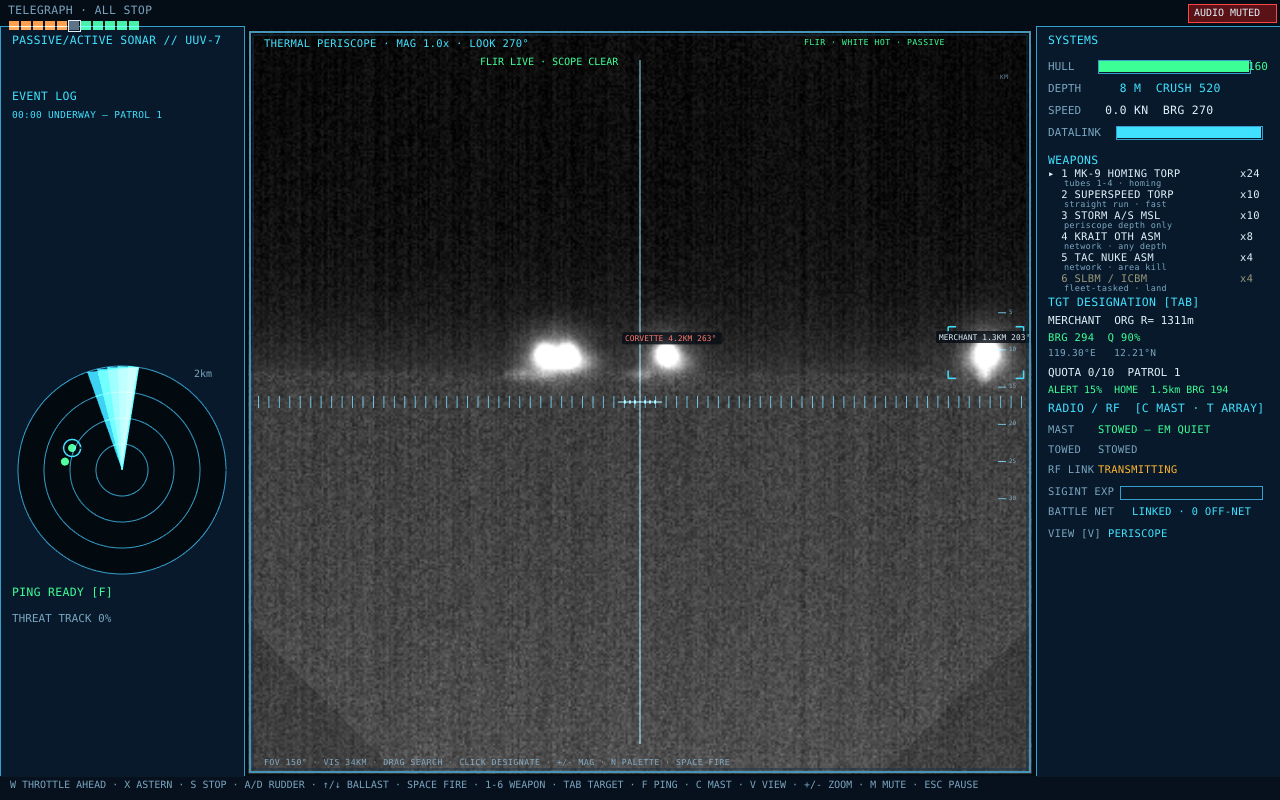
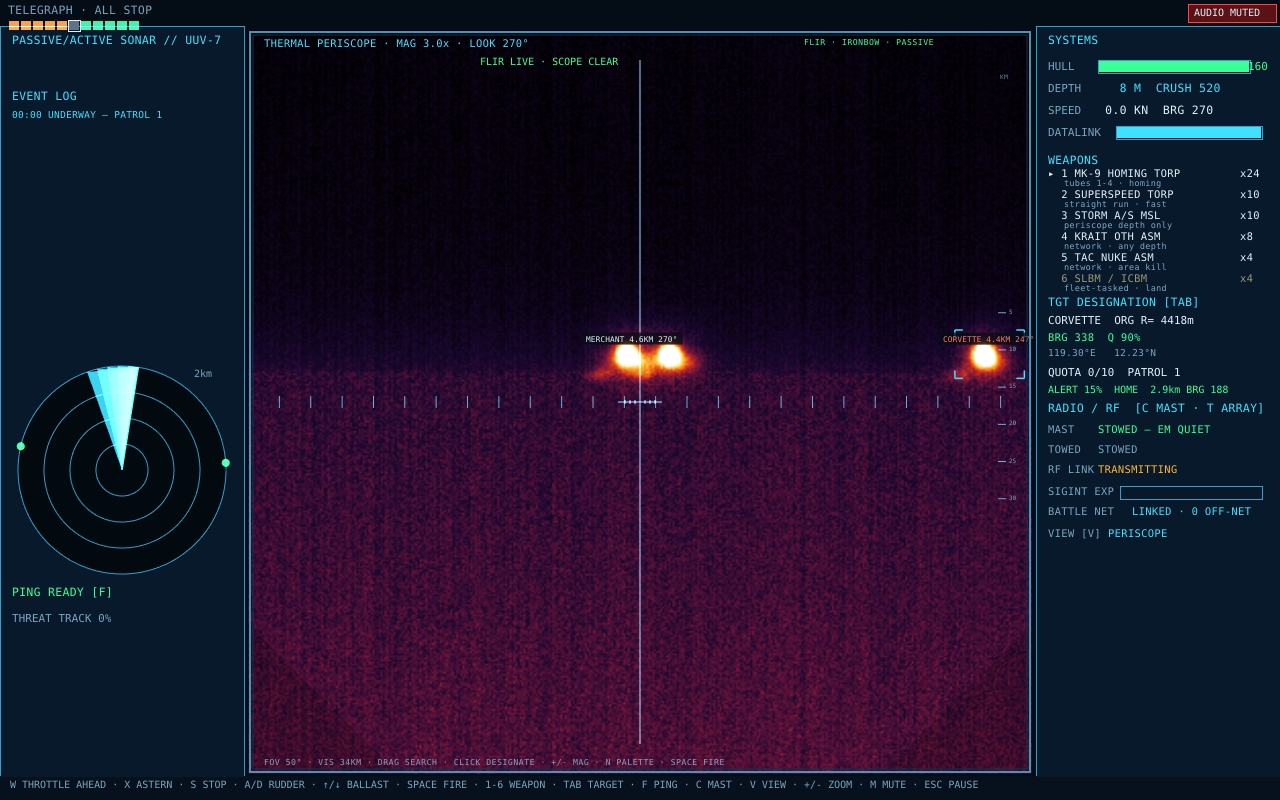
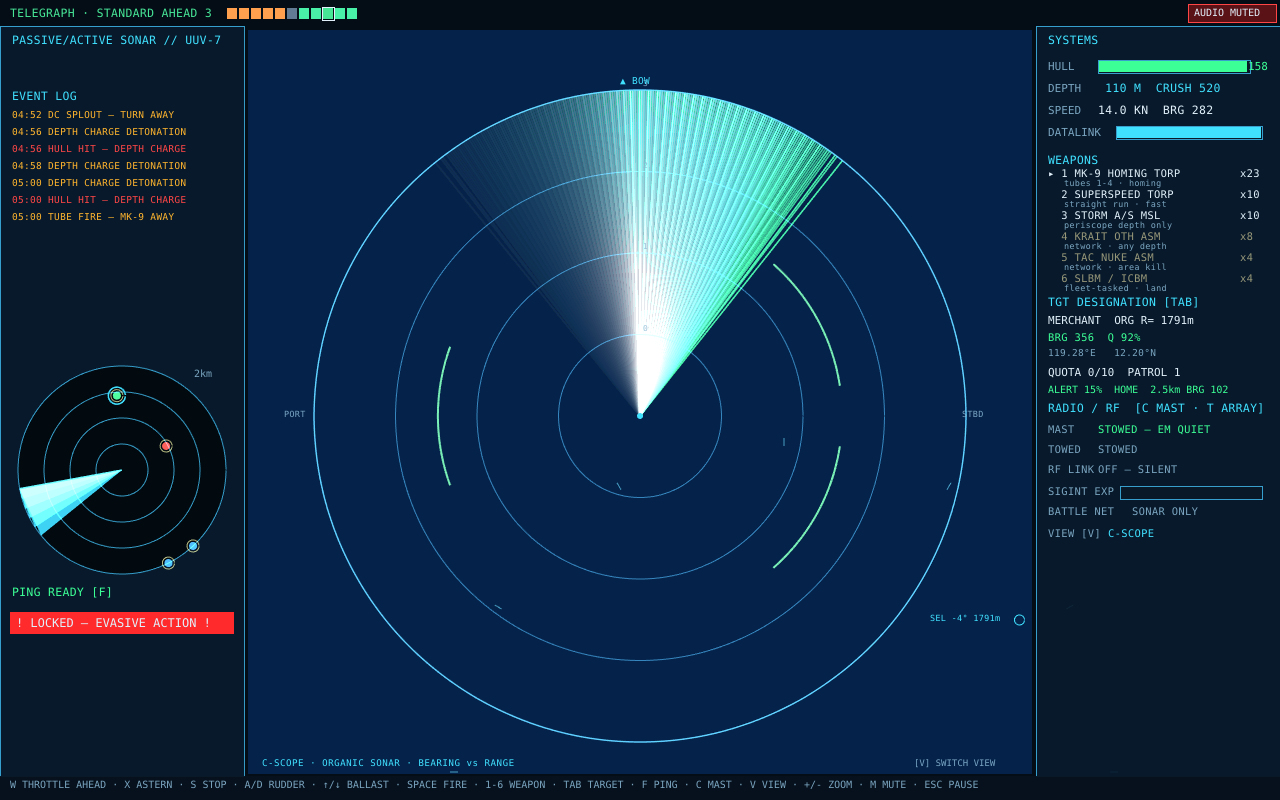
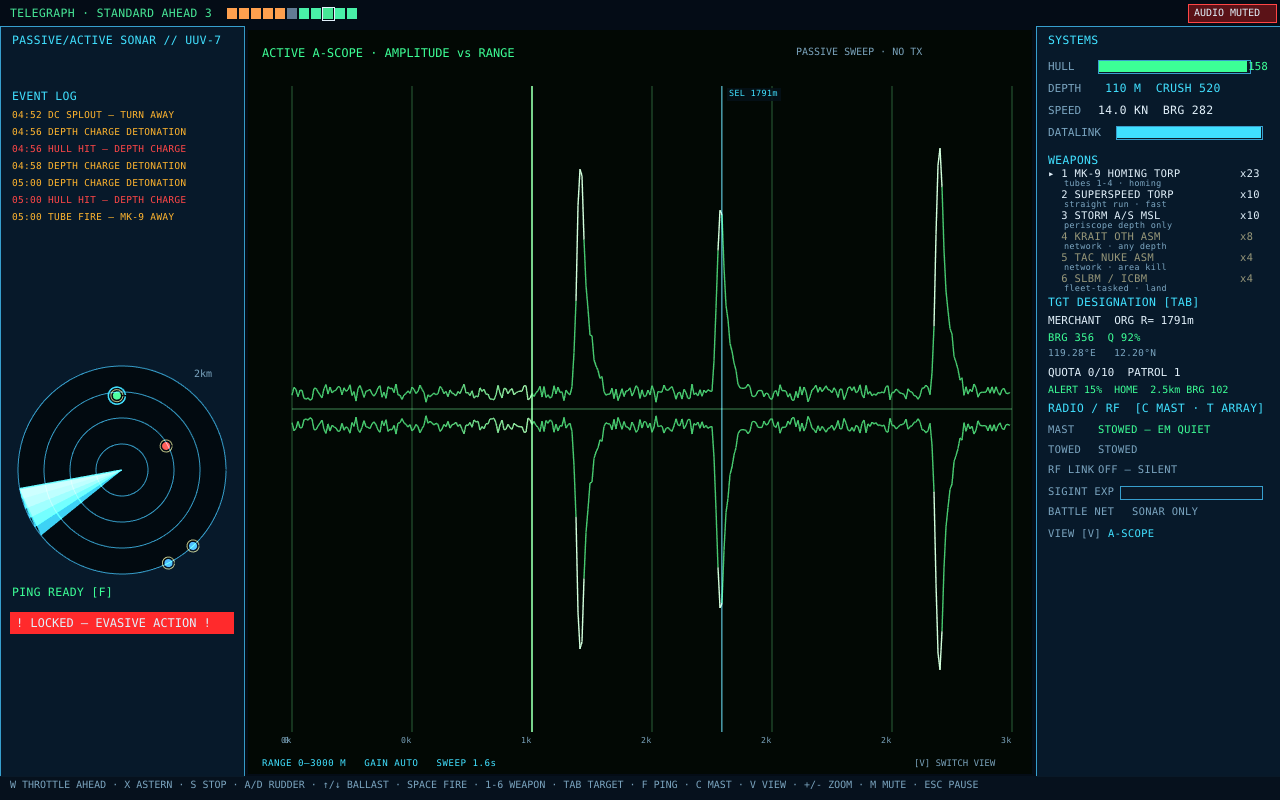
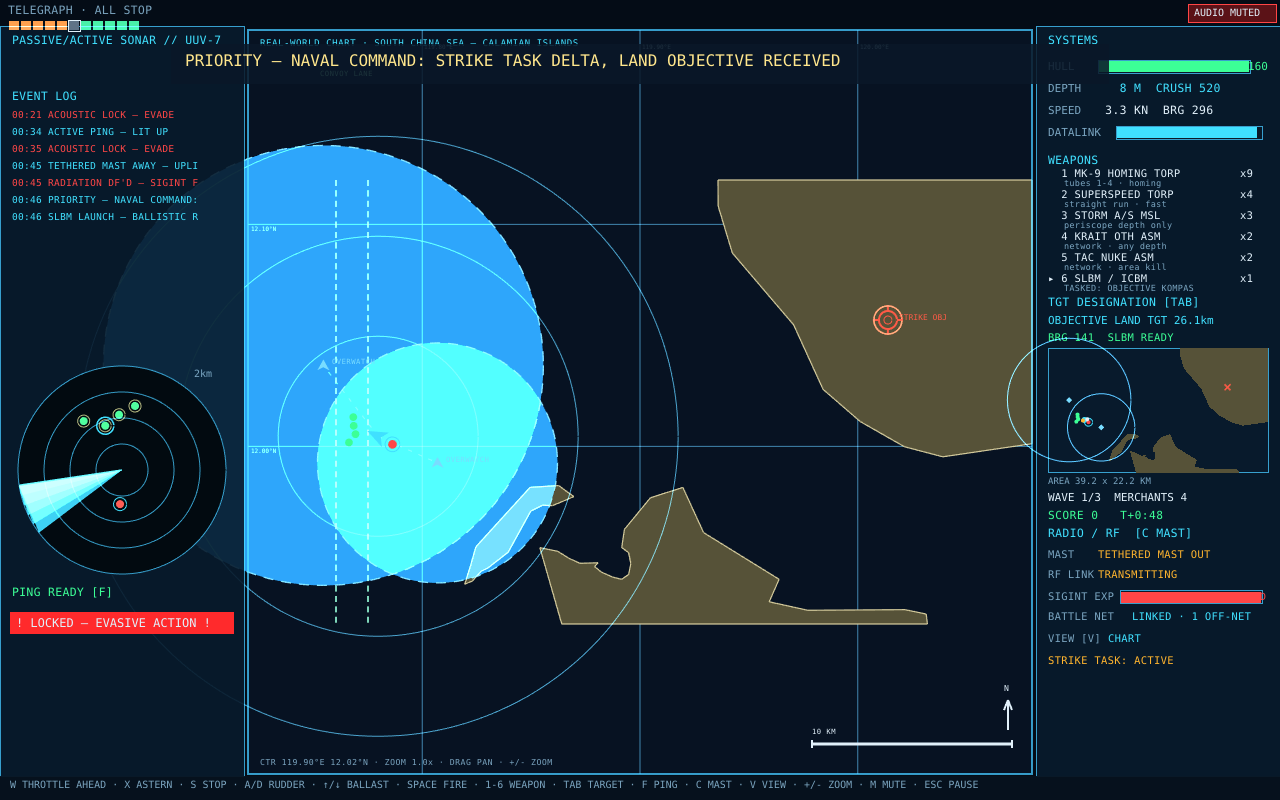
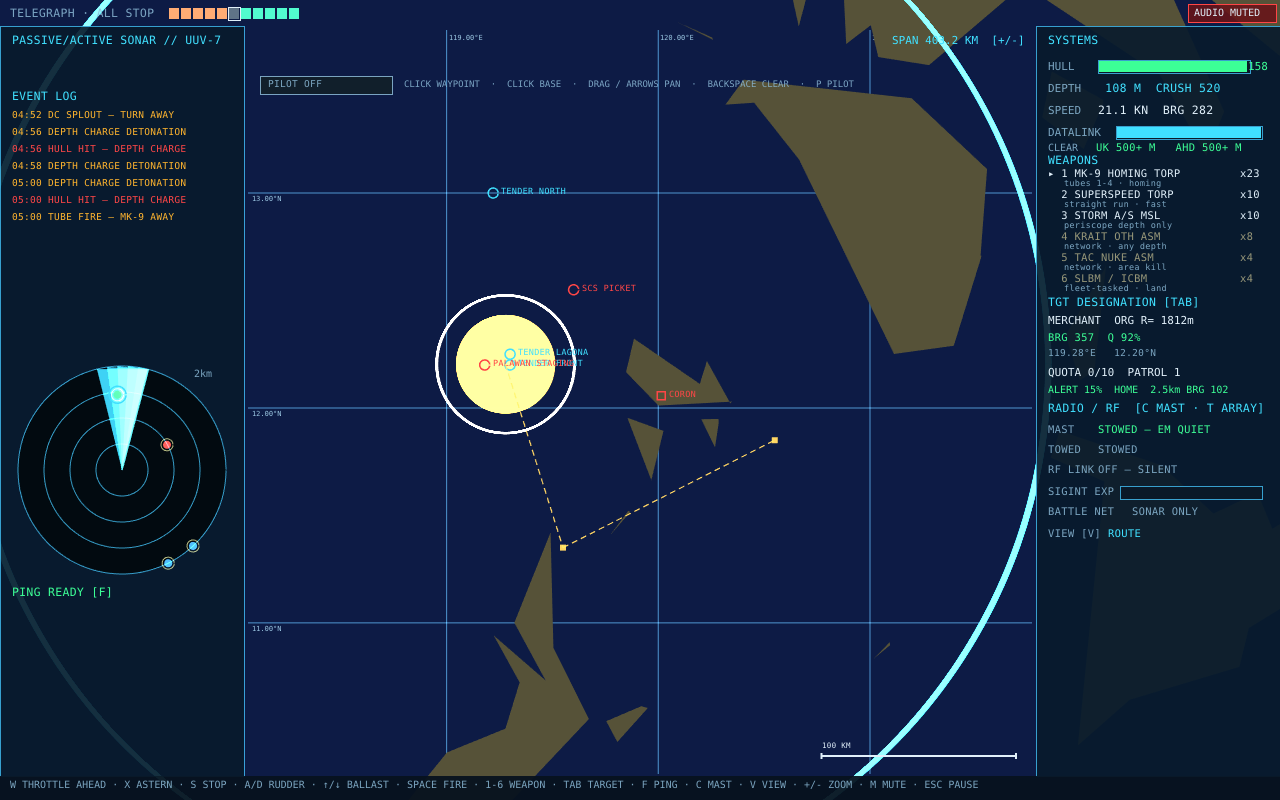
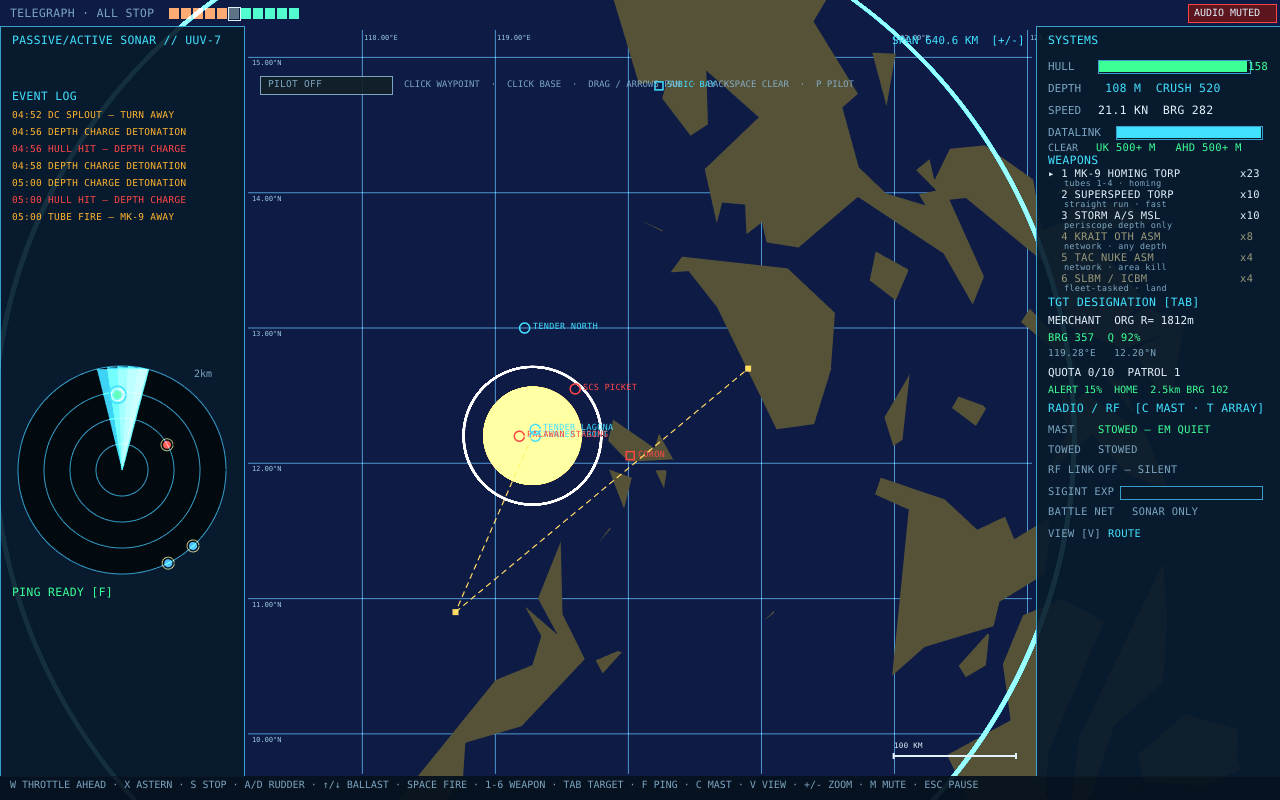
Positions are longitude and latitude. Speeds and weapon ranges stay in metres. The coastline is the Natural Earth 1:10 m land layer, baked into the binary, so the game never phones home for a map. Land slides the hull. A hard hit on the bottom destroys it. A gentle touch grinds until you rise. A torpedo, a ship-aimed missile, or a depth charge that runs onto land duds. A ballistic missile crosses the coast, and so does a tactical nuke aimed at a base.
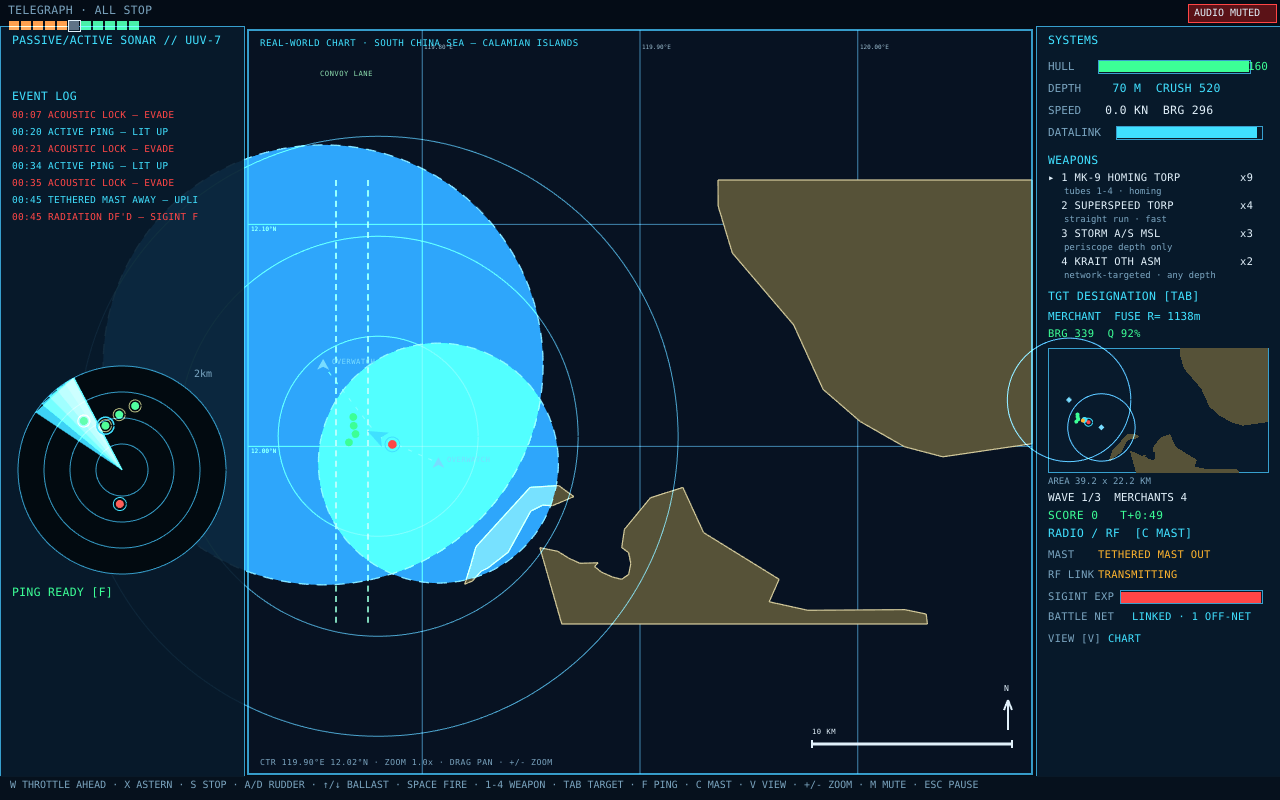
The camera zooms from a few kilometres across to the whole Earth. The route view is the same chart. Click to lay waypoints, including a charted base, and P hands the telegraph to the pilot. That pilot is separate from the combat autopilot that drives the title-screen demo.
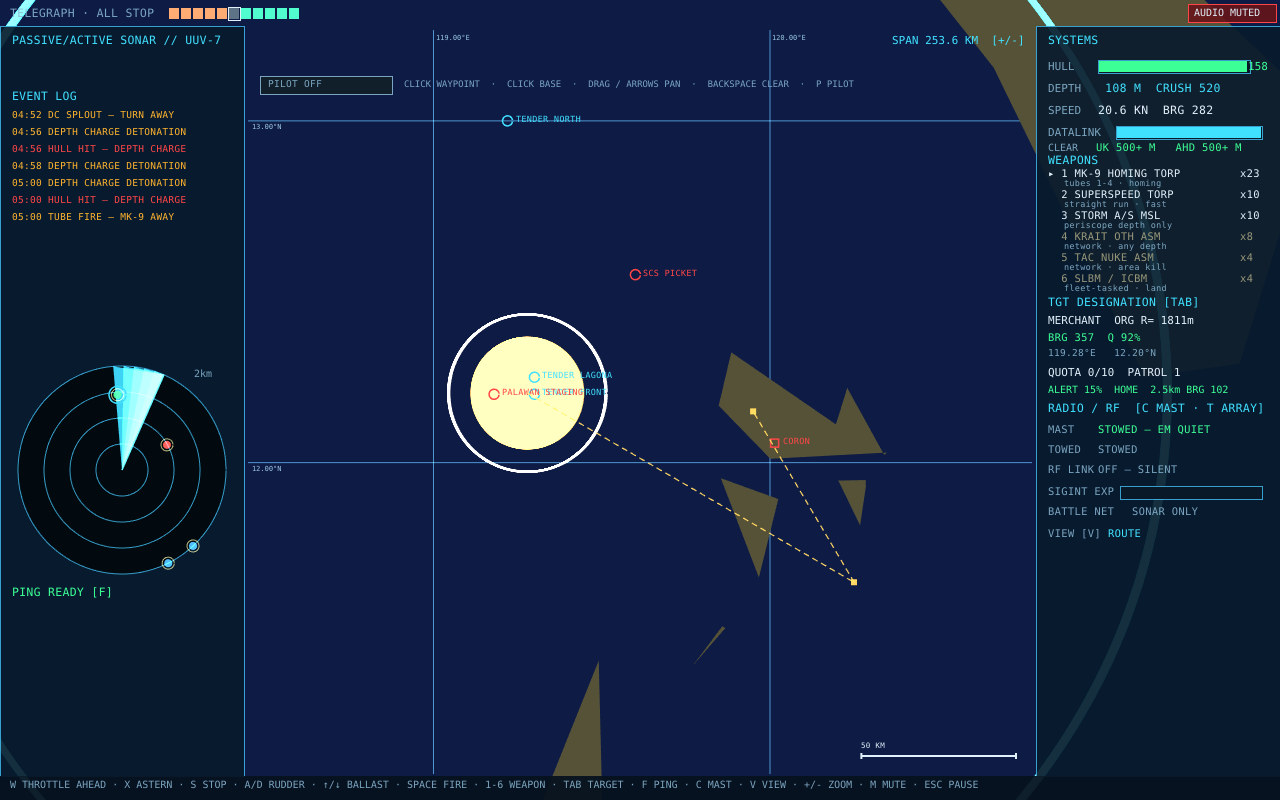
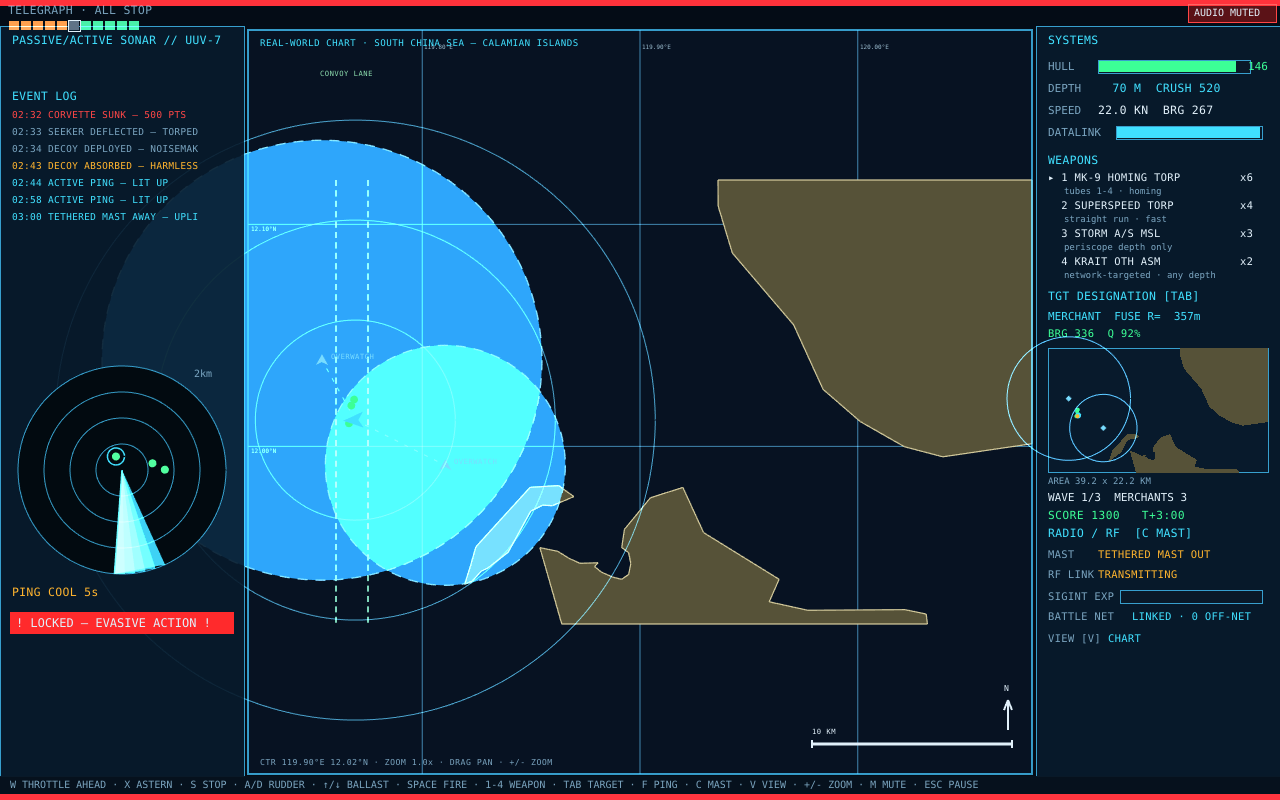
Your own sonar is short-legged. Friendly drone and AWACS nodes watch the surface inside a fixed coverage ring. The fleet can only be heard with the mast, the towed array fully streamed, or the boat at 12 m or shallower. Every ship in that ring then arrives as a hard track. Deeper than that, with the mast stowed and the tow not fully streamed, the live feed stops. Tracks you already paid for coast on as dead-reckoned estimates, tagged EST, and fade over about 80 seconds.
The KRAIT is the strike arm of that picture. Designate a contact the network holds and fire from any depth. The missile drinks the network on its own datalink, so you can cut your uplink after launch. The tactical nuclear round uses a wide burst. A ship shot uses the KRAIT network gate. A click on a live base is the difference: with the tactical nuke selected it stores a ground aim that launches on the uplink with no ship track. Stay outside it.
| W / X / S | Telegraph ahead, astern, all stop. The order sticks until you change it. |
|---|---|
| A / D | Rudder port / starboard |
| ↑ / ↓ | Ballast: rise / dive. Deeper is quieter. Depth does not slow the helm. |
| 1 – 7 | MK-9, supercavitating torpedo, STORM, KRAIT, tactical nuclear, SLBM, interceptor |
| Tab / click | Designate a target. With the SLBM selected, a click aims a base or an area. Blue force is never selectable. |
| Space | Fire the selected weapon |
| F | Active sonar ping. A clean picture, and a loud one. |
| C / T | Tethered RF mast, or the towed array. The fleet can only be heard with the mast, the tow fully streamed, or the boat at 12 m or shallower. The array is the long quiet watch: deep and slow. The radio panel says the speed or the wait when the key will not work. |
| K | Fleet sitrep. |
| V | Cycle the centre view. Tactical, sonar waterfall, 3D sonar, RF, route, periscope, bottom scan, C-scope, A-scope, LOFAR, weapon cam. |
| N | On the periscope or weapon cam, cycle the thermal palette. |
| + / − | Zoom the chart, magnify the periscope, or narrow the weapon-cam field of view. |
| P | Route pilot on or off. Click the chart to append a waypoint. |
| H / Esc | Keyboard help, which holds the simulation. Esc pauses. From the title screen, Esc quits. |
FUTURESUB is a for-fun game and a reference project for a specific kind of work: a local language model left to run a long, end-to-end development of complicated software. The point is the length of the path. A change in the simulation has to survive the unit tests, still look right on the console, and come out the other side as installers a person can run on a Mac, a Windows PC, or a Linux machine.
The codebase is split so that path is checkable without a person sitting at the screen. internal/sim is a deterministic model with no renderer and no input library. Step takes an order and returns events. The same seed plays the same war. The console, the audio, and the eleven views sit in the other half and read that model. An agent can change the war and prove it headlessly, then change the glass and capture a frame.
The test suite is the unattended referee. It covers hull and crush depth, sonar, the datalink, every weapon's launch rules, campaign traffic, friendly-fire, the coastline, and an autopilot that has to win the campaign, including on the real map. Meeting the merchant quota posts the next transit or the final sweep and leaves the phase running. The win is enemyCleared: every enemy base, drone, and ship, and also no live strike weapon and no live enemy torpedo. A separate probe, cmd/winprobe, runs several real-map seeds to completion and prints the win rate. Screenshot capture is a flag on the game itself, so a picture of the periscope or the waterfall is a build artifact, the same way a test is.
The outer loop is one command on one Mac. make releasedoes not ask questions. It cross-compiles five targets withCGO_ENABLED=0, packs a universal disk image, two Debian packages, two tarballs, and two Windows installers, and writes the checksums this page is built from. make site serves the result locally. Publishing is a later, separate command. The runbook is RELEASING.md, written so the next agent can repeat the release without rediscovering the toolchain.
That is the specimen. A simulation with a real coastline and seven weapons, a console with a lot of glass, and a distribution problem. Long enough that a model has to keep the whole product in mind, and closed enough that the machine can tell when the run is actually done.
docs/.make release builds every installer and the checksum list.make site rebuilds this page against those files, still on the same machine.